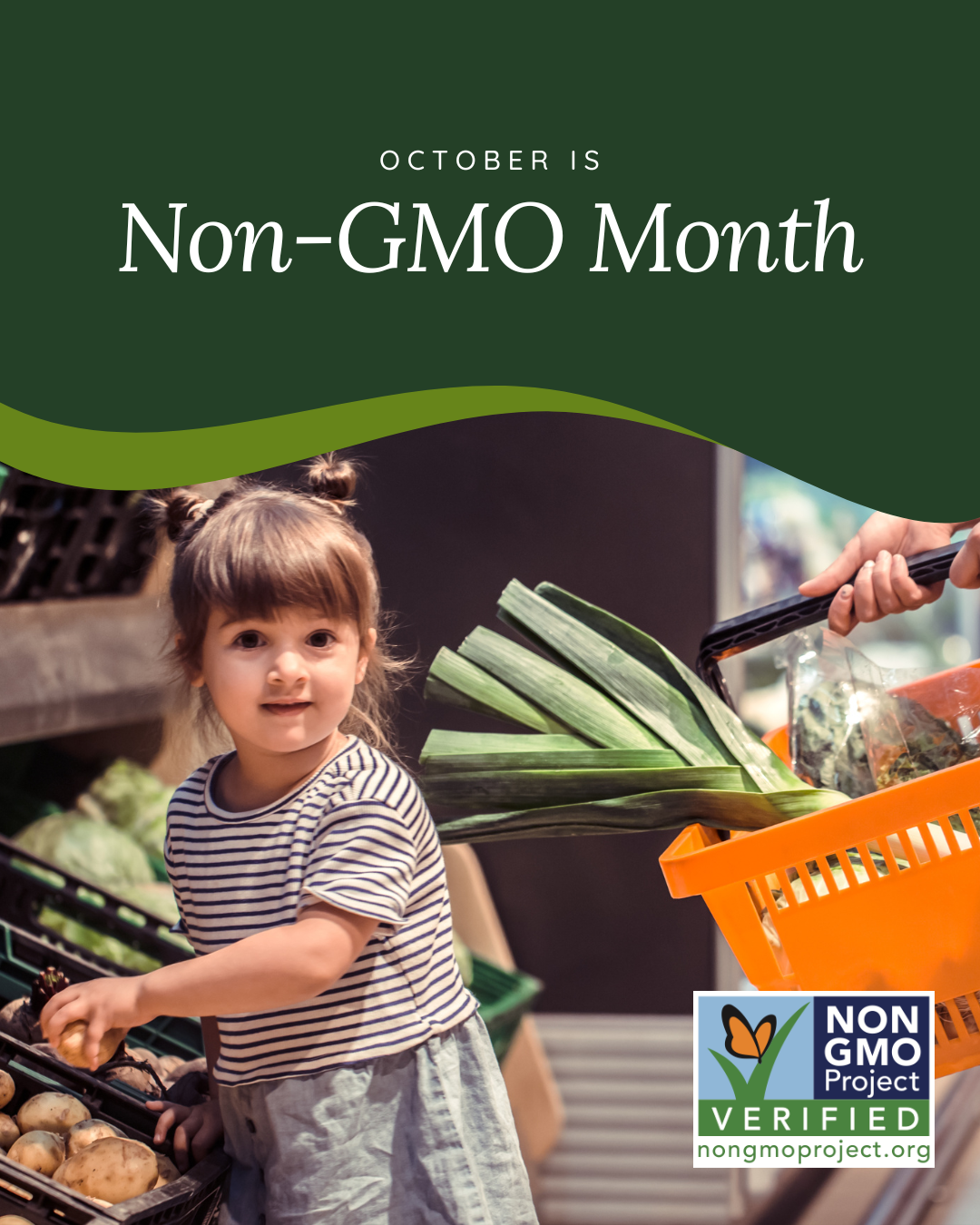
October is Non-GMO Month! Support the Non-GMO Project in preserving nature’s integrity.
Better with the Butterfly
Non-GMO Month is a time to celebrate transparency in our food system, support biodiversity, and protect our genetic inheritance for future generations. The Non-GMO Project believes that everyone has a right to know how their food was grown. As a nonprofit organization, our mission is to provide rigorous product verification and trustworthy education that empowers people to care for themselves, the planet and future generations.
What is Non-GMO Month?
Our annual celebration in October highlights the importance of transparency in our food system. Non-GMO Month supports farmers and brands who produce non-GMO products, backs retailers in their efforts to educate consumers, and encourages shoppers to make informed choices. Join us!
What are GMOs?
A GMO, or genetically modified organism, is a plant, animal or microorganism that has been subjected to biotechnology. Biotechnology includes techniques such as using synthetic genetic sequences to change the organism's genetic material (i.e., DNA or RNA), or forcing the combination of very unrelated organisms that would not normally reproduce in nature. GMO developers use biotechnology to alter an organism's fundamental characteristics. Learn more here.
Why back the Butterfly?
1. Maintain transparency and choice. Transparency in our food system empowers individuals to make choices that align with their dietary preferences, health requirements and personal beliefs. By supporting informed choice through appropriate labeling, we can encourage food companies to be more transparent about their ingredients, sourcing and production methods. Informed choice in our food system is not simply a matter of personal taste; it's a fundamental right.
2. Create a meaningful shift toward organic and regenerative. Non-GMO is the first step toward organic and regenerative farming. Non-GMO reduces farmers' dependence on synthetic fertilizers and agrochemicals, creating a pathway to better, more holistic systems.
3. Reduce pesticide use. Over 90% of soy and corn grown in the United States is genetically engineered to withstand weedkillers. Non-GMO crops help farmers exit the pesticide treadmill while supporting clean ecosystems and waterways.
4. Preserve biodiversity. Protecting nature's genetic diversity helps maintain resilient ecosystems, healthy soil, clean water and abundant wildlife. A non-GMO food system helps to preserve the Earth's biodiversity.
5. Support non-GMO research and education. The Non-GMO Project is North America’s only organization tracking new GMOs in development. Our dedicated research team follows the latest in the biotech industry, which is growing faster than ever. Our ability to educate millions of people with critical information about GMOs is made possible by our donors.
6. Support food sovereignty. Patented GMO seeds place the world's food resources in the hands of multinational corporations. Agricultural monopolies restrict farmers’ choices and use their immense power to shape policy to their own benefit. We believe farmers have the right to preserve a rich array of genetic resources, maintain diversity that is essential for natural future crop improvement, and build resiliency to changing environmental conditions.
7. Uphold equity. Genetically engineered crops, agrochemicals, and associated technologies are expensive for farmers, especially smallholder farmers who grow over 70% of the world’s food. By cultivating traditional and locally-adapted crop varieties, these farmers contribute to global agricultural biodiversity. Fostering inclusive and resilient food systems that benefit farmers of all scales and regions is essential to ensuring global food security and sustainability.
8. Believe in something more than empty promises. Despite biotech food industry claims, there is no evidence that any of the GMOs in widespread commercial production offer meaningful increased yield, drought tolerance or climate resilience. Most of these empty claims are just marketing – and not backed by science. Small acts lead to remarkable movements. Help us continue our work!
Your dollars help fund our research, our educational campaign programming and our Equitable Transfer Program, which supports businesses led by people of color in pursuing Non-GMO Project verification.
Sign up for our monthly newsletter for non-GMO updates, news, articles, giveaways and more.
Follow us on our social media channels. Share our content. Use #NonGMOMonth or #BetterWiththeButterfly when sharing your favorite Verified products or fall recipes.
Every time you see a label with the Butterfly, you know that brand has made a commitment to the most rigorous non-GMO standard. Find Non-GMO Project Verified products here.
Together, small acts lead to powerful movements – and good things follow.
The non-GMO movement has been featured in many award-winning documentaries and videos that are a perfect watchlist for October:
Celebrate Non-GMO Month this October
This October, celebrate transparency and biodiversity in our food system and protect our genetic inheritance.
The Non-GMO Project is a nonprofit organization providing rigorous product verification and trustworthy education. Our mission is to empower people to care for themselves, the planet and future generations.
Your support helps to build and preserve our non-GMO food supply and create meaningful shifts toward regenerative agriculture.
Educate your customers about Non-GMO Month by using some of these tools. Encourage shoppers to look for the Butterfly!
1. Order Non-GMO Month signage kits!
Limited offer! We will ship you one (1) complimentary in-store signage, delivered directly to your storefront! Order a kit.
2. Non-GMO Month media kit
Non-GMO Month is the perfect time to highlight your commitment to a natural, non-GMO food system. Our media kit provides free resources for you to use throughout October, including:
Downloadables, flyers and ads
Ready-to-post graphics for social media
Talking points highlighting the GMO issue
Valuable data points on GMOs and natural shoppers
3. Pocket Guide
Where are GMOs showing up in the produce aisle? Use our handy Pocket Guide to GMOs in Produce and keep the produce aisle natural.
4. Stay up to date!
Sign up for monthly newsletter and stay up to date on all that is happening in the non-GMO retail space.
Non-GMO Project Brand Summit
The second annual Non-GMO Project Brand Summit is now complete. If you're a participating brand in our Product Verification Program, join us next year!
Non-GMO Month is the perfect time to highlight your Non-GMO Project verification. Check out our new media kit and access free resources to use throughout the month, including:
The Non-GMO Project is the only nonprofit, third-party certification program working toward GMO transparency and non-GMO food choices. When you donate to the Non-GMO Project, you’re helping to build a more transparent, natural and sustainable food system that is better for people and the planet.
We use cookies to enhance your experience. We believe your data is your property and support your right to privacy and transparency. Accept all or manage your preferences. See our Privacy Policy.
Privacy Policy
Manage your cookie preferences below:
Essential cookies enable basic functions and are necessary for the proper function of the website.
Name
Description
Duration
Cookie Preferences
This cookie is used to store the user's cookie consent preferences.
30 days
Google Tag Manager simplifies the management of marketing tags on your website without code changes.
Name
Description
Duration
cookiePreferences
Registers cookie preferences of a user
2 years
td
Registers statistical data on users' behaviour on the website. Used for internal analytics by the website operator.
session
Statistics cookies collect information anonymously. This information helps us understand how visitors use our website.
Google Analytics is a powerful tool that tracks and analyzes website traffic for informed marketing decisions.
Contains information related to marketing campaigns of the user. These are shared with Google AdWords / Google Ads when the Google Ads and Google Analytics accounts are linked together.
90 days
__utma
ID used to identify users and sessions
2 years after last activity
__utmt
Used to monitor number of Google Analytics server requests
10 minutes
__utmb
Used to distinguish new sessions and visits. This cookie is set when the GA.js javascript library is loaded and there is no existing __utmb cookie. The cookie is updated every time data is sent to the Google Analytics server.
30 minutes after last activity
__utmc
Used only with old Urchin versions of Google Analytics and not with GA.js. Was used to distinguish between new sessions and visits at the end of a session.
End of session (browser)
__utmz
Contains information about the traffic source or campaign that directed user to the website. The cookie is set when the GA.js javascript is loaded and updated when data is sent to the Google Anaytics server
6 months after last activity
__utmv
Contains custom information set by the web developer via the _setCustomVar method in Google Analytics. This cookie is updated every time new data is sent to the Google Analytics server.
2 years after last activity
__utmx
Used to determine whether a user is included in an A / B or Multivariate test.
18 months
_ga
ID used to identify users
2 years
_gali
Used by Google Analytics to determine which links on a page are being clicked
30 seconds
_ga_
ID used to identify users
2 years
_gid
ID used to identify users for 24 hours after last activity
24 hours
_gat
Used to monitor number of Google Analytics server requests when using Google Tag Manager
1 minute
Marketing cookies are used to follow visitors to websites. The intention is to show ads that are relevant and engaging to the individual user.
Used by Google Ads to link clicks on ads to conversions that happen on a different page or device, enabling accurate attribution of advertising performance.
Used by Google Ads to link clicks on ads to conversions that happen on a different page or device, enabling accurate attribution of advertising performance.
3 months
You can find more information in our Privacy Policy.